

Team USA: The Generational Shift Got Official Paperwork
Team USA Just Announced the Future & It’s Guard-Centric Chaos
It’s about 90% hype. But it’s the good kind of hype. The kind that feels earned.
The United States women’s roster for the FIBA World Cup qualifiers dropped, and instead of feeling like a ceremonial list of safe names, it feels like a generational checkpoint. This is not a slow transition roster. This is not a “let’s sprinkle in the kids” situation.
The names on the list are so good even casual fans…like your mother who hasn’t watched a minute of women’s basketball would be able to recognize.. Paige Bueckers, Aaliyah Boston, Caitlin Clark, Angel Reese, Kelsey Plum, Kiki Iriafen, Sonia Citron, Kahleah Copper, Chelsea Gray, Dearica Hamby, Rhyne Howard, and Jackie Young.
That’s not a roster, that’s called Olympic domination.
You’ve got championship veterans. You’ve got Olympic-caliber floor generals. You’ve got rookies who just bent the economics of the WNBA. You’ve got players who stretch the floor to 30 feet and bigs who can sprint in transition and guard across positions. And what stands out most isn’t just the talent. It’s the stylistic shift embedded inside it.
This roster is guard-heavy, pace-driven, and perimeter-minded in a way older USA teams simply weren’t.

This Isn’t the Traditional USA Blueprint
For years, the identity of Team USA women’s basketball has been built on frontcourt dominance. Control the glass, feed the post, and make sure you get the ball to either A’ja Wilson, Breanna Stewart, Lisa Leslie, or Candace Parker (not at the same time obviously).
That model worked because the personnel demanded it.
This roster tilts differently.
You’re talking about a USA team this year where the tempo can and will be pushed by multiple ballhandlers, and not just guards eiter.
Paige can create off the bounce and in space. Caitlin can shoot from the logo and bend defensive geometry in ways international teams aren’t used to seeing. Chelsea Gray can manipulate a halfcourt defense like a chessboard. Kelsey Plum and Jackie Young bring downhill pressure and shot-making. Rhyne Howard gives you length and scoring versatility on the wing.
Even the frontcourt pieces don’t play like traditional anchors. Aaliyah Boston runs. Angel Reese rebounds everything in her zip code, play makes and then some. Dearica Hamby defends multiple spots and flies in transition. Kiki Iriafen has mobility and range.
This isn’t a “throw it inside and stand still” roster.
That’s the evolution of the women’s game showing up in international form.
The Real Drama Is Internal
Let’s be honest. This team is going to win. The United States rarely enters these competitions as anything but the overwhelming favorite. That’s not the debate.
The real intrigue is inside the roster.
This generation is competitive in a way that doesn’t hide. There are subtle hierarchy battles happening here, and international play has a way of revealing things. FIBA compresses roles. It limits possessions. It forces efficiency. It exposes defensive discipline. You don’t get to freelance your way through it.
So who emerges as the clear leader of this new era? Who closes games? Who sets the tone defensively? Who commands the huddle? Who becomes the international assassin?
Paige and Caitlin will always be linked. Angel and Boston will always be compared. Jackie and Kelsey have championship pedigree. Chelsea Gray remains the steady hand.
And this feels like the start of that definition phase.
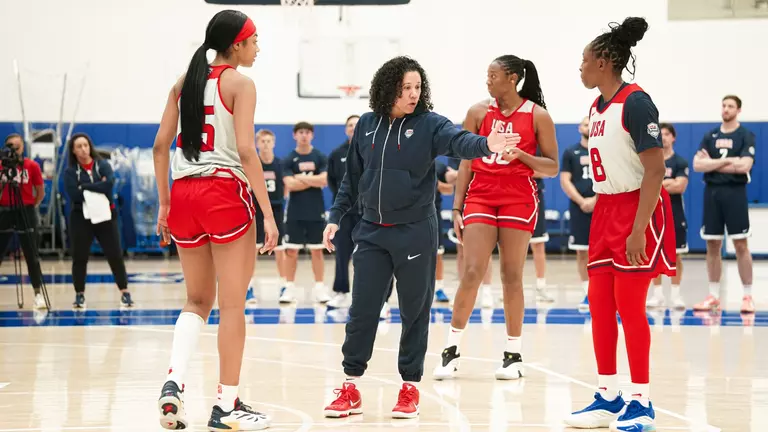
This Roster Feels Symbolic
The most interesting part of this announcement isn’t the names themselves. It’s what the composition signals. The center of gravity in women’s basketball is shifting outward. Guards are louder. The pace is faster. Spacing matters more. Shot creation from the perimeter isn’t a luxury anymore. It’s foundational.
This roster mirrors that evolution perfectly.
It doesn’t abandon physicality. It doesn’t abandon defense. It just layers modern skill on top of it. You can see the direction the sport is heading, and USA Basketball is leaning into it rather than resisting it.
From a South Florida lens, there’s also pride in seeing Jose Fernandez connected to this process. Miami fingerprints on global basketball never get old. The game expanding while your region stays relevant is always a win.
Over the next four to six months, this group is going to play a brand of basketball that’s not only dominant but entertaining. And that combination is dangerous.
The generational shift isn’t theoretical anymore.
It’s wearing USA across the chest.

